Friday, March 16, 2012

Mosaic Reflection

For my mosaic, I decided to do an olive branch, which is one of the most famous Christian symbols. The olive branch represents prosperity and peace. In the Bible, God decides to punish all human-kind for their wickedness and sinful lives by creating a giant flood. However, he tells a noble and kind man, named Noah, about his plans in a dream. He also tells him to build a giant arc, and stay in it with his family, as well as with one female and one male of all species from the animal kingdom. The flood lasts for years, until Noah decides to send a dove to search for land. The dove returns with an olive branch, meaning that the fierce floods were over. Thus, the olive branch represents the beginning of peace and prosperity on Earth.
Honestly, the creation of this mosaic was much more difficult than I thought it would be. It was a very tedious job, especially with the challenging shape of the olive branch. The branch had many curved and round bits, which were difficult to cover with square tiles. I also made a very big mistake, which took me a lot of time to correct. I believed that purple background would fit well with the green frame, as well as the dark green color of the olive branch. However, the purple showed to be too dark, and the branch was barely visible. So, I had to take yellow, which was a much lighter color, to make the branch the central figure of the mosaic. It was very difficult glueing the yellow tiles over the purple ones, and covering them completely.
I had trouble creating a small A4 mosaic with paper, even though all the tools were available to me, from paper, to scissors, glue, etc. However 1500 years ago, it must have been very hard to even get the glass tiles, the strong cutters, and all other tools, before even beginning the making of the mosaic on church walls. The actual planning and creating of the mosaic must have been extremely difficult. The scale of the Byzantine mosaics is also magnificent, and it must have taken the artists a very long times to successfully complete them.

Sunday, February 26, 2012

Christian Saints

Research and write a mini-bio on a saint from either the Orthodox or Catholic faith.

One of the most important, and most widely worshipped and honored saints in Serbia is the Eastern Orthodox saint, St. Sava. He was born in 1174 and he died in 1236. Saint Sava was born into a royal family. His real was Rastko Nemanjic, and he was the youngest son of the Grand Serbian Prince, Stefan Nemanja. St. Sava's father was the founder of the Nemanjic dynasty. Saint Sava left his home at an early age, and he became a monk. He acquired his monastic name, Sava, in the monastery. The complex of churches and monasteries on the Greek Mount Athos, called Hilandar, were found by St. Sava. In 1219, Sava was recognized by the Patriarch of Constantinople as the first Archbishop of the Serbs. However, Saint Sava is mostly known and appreciated for as the founder of the Serbian orthodox Church. He is the patron saint of all school children/students in Serbia, and Saint Sava's Day is celebrated on January 27th, every year. Sava died in Trnovo, which was the capital of the Second Bulgarian Empire. At that time, it's ruler was Ivan Asen II of Bulgaria. Saint Sava was planning to build more monasteries in Trnovo, for Serbian monks, and also establish a hospital for the Syrian pilgrims. However, he unexpectedly died of pneumonia. The cathedral in Belgrade is dedicated to St. Sava, as it is built in the place where the Ottoman Turks burnt his remains, around the 16th century. This church is one of the largest Eastern Orthodox cathedrals in the world.


Wednesday, February 22, 2012

Women in Politics

Research a modern-day female political leader that you think has had great influence
in making and changing laws. Provide a mini-biography and explain why you chose her.
(approximately 250 words or 2 paragraphs).


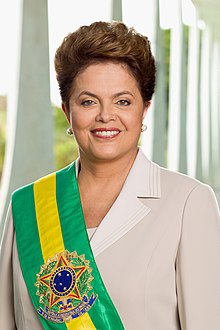
The woman that I decided to research is Dilma Rouseff, who is the current president of Brazil. Mrs. Rouseff was born in 1947, in Belo Horizonte, Brazil. Her father was a Bulgarian immigrant, and she was raised in a middle class household. When she was in her twenties, Mrs. Rouseff became socialist, and she fought against military dictatorship. That is the reason she was arrested in 1970, and was supposedly severely tortured. Once she was released from prison, Dilma Rouseff found the Democratic Labour Party or the PDT. Before becoming president of Brazil, Mrs. Rouseff also served as the Minister of Energy, in 2002. She was invited to be in this position by the former president, Luiz Inácio Lula da Silva. In 2005, a huge political scandal took place, when the Chief of Staff of Brazil, José Dirceu, got involved in a corruption scandal. After this, Mrs. Rouseff decided to run for president. She won the election on 31st October 2010, and became the 36th President of Brazil, as well as the first woman to be in that position.
I chose to research this woman for a variety of reasons. First of all, she is leading one of the most powerful economies and one of the biggest countries in the world, and is quite successful. Dilma Rouseff is also in the third position on the Forbes “Most Powerful Women in Politics” list. However, what I find really fascinating about this woman is the fact that she kept on fighting for what she believed in, and nothing stopped her in her dreams and ambitions, not even going to jail. This shows that she is very brave, determined, and intelligent, much like the Byzantine Empress Theodora was.


Sunday, February 5, 2012

Why did Rome fall?

Historians have been debating for years about the reason of the fall of one of the greatest empires on Earth, the Roman Empire. However, even today, there was no definite conclusion reached, so there are still many reasons and speculations about why Rome came to it's final and definite end. Some historians believe that Rome fell because of it's geographical positioning. Because of it's shape and size, Rome needed a lot of soldiers and resources to protect itself against the barabrians. Another theory is that Rome fell ebcasue of the economic decline, and inflation. Despite the growth of government, and army, Romans kept importing luxury goods, causing a major fall of the economy. Starting with Diocletian, the government of Rome kept on growing, causing much more corruption, civil wars, and murder of the emperors. It is also speculated that the empire fell because of the decline in the work force. High death rate among the Romans increased, and the number of slaves dramatically decreased. Also, in Rome, there was a lack of technology. As the army, government, and empire grew, there were fewer workers to produce the demans of the empire. Rome had very little machinery that would make human labor more productive. Finally, Rome could have fallen because of the military defeat; the army was no longer strong enough to beat the barbaric tribes that kept on invading.
Personally, I believe that the main reason for Rome's downfall was the fact that invaders kept coming in. The barbaric tribes kept growing larger, and many of them, including the Vandals and the Huns had many invasions on the Roman Empire. Even though the Roman army kept fighting, the barbaric tribes eventually won. Despite the economic disaster, and the government decline, I do believe that the invaders were the ones who caused the Roman empire to fall. The economy and the government would have probably been restored, if a powerful, strong leader/emperor took the power. However, after Constantine's death, that never happened, and the invaders took advantage of Rome's many economic and political issues.


Jesus Christ Superstar Movie Review


Messiah or Not? : Jesus Christ Superstar

Jesus Christ Superstar is a controversial rock opera that revolves around the life of one of the most influential figures in human history, Jesus Christ. Throughout the whole movie, you are left wondering whether Jesus was truly a Messiah, or whether he was just a prophet, who was not the long-expected savior of the Jews, or the Son of God. This unique version of the well-known Biblical tales is told from the point of view of one of Jesus’ followers, Judas Iscariot. Astonishing musical numbers, as well as a very talented cast will sure make watching this movie enjoyable and worthwhile.

Opening with a song by Judas (Carl Anderson), who, very harshly, expresses his anger and unhappiness with Jesus (Ted Neeley), this movie promises to be filled with tension and conflicts. However, despite Judas’ accusations, Jesus keeps spreading his message. He accepts all sinners to be his followers, including a prostitute, Mary Magdalene, who is played by Yvonne Elliman. Filmed on the plains of Jerusalem, Israel, this 70’s classic was based on the original Broadway musical by Andrew Lloyd Webber and Tim Rice.  

Jesus Christ is known among his followers, as well as among the Jews in Judaea and Galilee, as the performer of miracles. He is also seen as the healer of the sick, and as the Messiah sent from God to save the Jews from the reign of the Romans. His teachings tell people about eternal love, forgiveness, and acceptance. However, not everyone is fond of Jesus Christ, the “Superstar”. Jewish priests fear that he is gaining too much power, and the Romans are fearful of the riots that could emerge among the Jewish population. Despite being on the edge of great success and glory, Jesus is a very humble character, who is kind and generous towards everyone. Judas, on the other hand, is rebellious and is someone who disagrees with the decisions of his friend and teacher. He is greatly frightened by the powerful Roman leaders. Finally, Mary Magdalene is a very calm and loving woman, despite her portrayal in society.

One of the most disturbing, and definitely one of the most prominent parts of this rock opera, is when Jesus is faced with the isolated sufferers of leprosy. The lepers approach Jesus with pleading cries: “Won’t you touch; won’t you heal me, Christ?” At first, Jesus is willing to help them, but as more and more lepers start emerging, Jesus becomes overwhelmed by their individual desires, crying out: “There’s too little of me! Leave me alone!” One of the most intriguing characters was probably Peter, one of Jesus’ most loyal followers. Despite protecting and believing in Jesus, Peter denies knowing him three times, just as Jesus has predicted. This shows that, in Peter’s case, shame and fear was greater than the belief and loyalty to Christ.  

I would recommend this movie to all of those who are not very judgmental and who are open-minded, because this rock opera is quite intriguing.  Small children would probably find it boring, and would not understand the key concepts. I would rate this movie 7/10 stars. The soundtrack is very good, and the singers/actors really portray the emotions of the characters. However, as I said above, some of the ideas expressed in this movie could be considered controversial by religious people. Jesus Christ Superstar is a movie that you will either love or hate; but despite all the critical remarks, it is a timeless 70’s classic that you should definitely see!


Sunday, November 27, 2011

Who do you think was a more important leader, Caesar or Augustus?


Personally, I beleive that Augustus was a much better leader, politician and emperor in general, compared to Caesar. Caesar killed many people, who hurt many innocent women and children, and even though he was loved by many of the poorer people in Rome, he made many enemies. He defied the republic, and declared a civil war, knowing that he was hurting many of his own people, that believed in him and trusted him to make the right decisions. Augustus, however, made many reforms, and like he said himself, Rome was all clay and bricks, until he made it the city of marble. Augustus started importing grains and many other products from Africa and other nations, therefore increasing trade and building a better economical situation for Rome. He created a great protection for the Roman empire, with an army of over 150,00 highly skilled soldiers, all of whom were Roman citizens. Augustus also constructed many marble palaces, fountains and public buildings. He made conquests in modern-day Hungary and Romania, stretching the borders of the Roman Empire. Finally, Augustus made numerous reforms to the law and tax systems, fighting against unfair, greedy tax collectors, as well as corruption. However, most importantly, after Augustus' rule, Rome entered a glorious period in it's history, called the Pax Romana. During this time, arts and science flourished, and Rome was not involved in many wars. Economy was stable, and people lived in peace.
In conclusion, even though Julius Caesar fought for the rights of many underpriviliged citizens, and attempted to expand the Roman Empire, Augustus still had a much more positive impact on Rome's people, as well the city of Rome itself. During his rule, there was much less crime, and he was a lot less blood-thirsty in comparison to his great uncle, Caesar.

Tuesday, November 22, 2011

Julius Caesar- A Reformer or a Dictator?

I believe that despite all the great things he has done for the Roman empire, Julius Caesar was a dictator, and did seek glory for himself. For example, it is a historical fact that Caesar made some reforms to the Senate, in order to have more of his supporters in it. That way, he believed he could gurantee to stay in power, and not get overthrown by the Senate. Also, if he treated all of the defeated enemies with care, he wouldn't have conquered so much of Gaul and Britain. In order to establish new colonies and create new allies, you have to fight, and that is exactly what Caesar did. When Ceaser proclaimed the dictator of Rome for his whole lifetime, he obviously contradicted some of the basic rules of a republic. In the Roman republic, a dictator was only in charge during a time of big crisis or emergency, which led many to believe that Caesar was against Rome's original form of government.
Caesar also showed his greed for power when the Senate decided that Pompey should be the one ruling over Rome. Ceaser decided not to give up his army, and not to stop ruling, even after he has been warned. He crossed the Rubicon river, and marched into Rome with 5,000 soldiers. He knew that by doing this he would start a civil war, and yet, he still didn't care about all the innocent people that could get killed, and all the homes and farms that could be ruined, leaving many people jobless again. He wanted his power, and was going to do anything to regain it.