Sunday, November 27, 2011

Who do you think was a more important leader, Caesar or Augustus?


Personally, I beleive that Augustus was a much better leader, politician and emperor in general, compared to Caesar. Caesar killed many people, who hurt many innocent women and children, and even though he was loved by many of the poorer people in Rome, he made many enemies. He defied the republic, and declared a civil war, knowing that he was hurting many of his own people, that believed in him and trusted him to make the right decisions. Augustus, however, made many reforms, and like he said himself, Rome was all clay and bricks, until he made it the city of marble. Augustus started importing grains and many other products from Africa and other nations, therefore increasing trade and building a better economical situation for Rome. He created a great protection for the Roman empire, with an army of over 150,00 highly skilled soldiers, all of whom were Roman citizens. Augustus also constructed many marble palaces, fountains and public buildings. He made conquests in modern-day Hungary and Romania, stretching the borders of the Roman Empire. Finally, Augustus made numerous reforms to the law and tax systems, fighting against unfair, greedy tax collectors, as well as corruption. However, most importantly, after Augustus' rule, Rome entered a glorious period in it's history, called the Pax Romana. During this time, arts and science flourished, and Rome was not involved in many wars. Economy was stable, and people lived in peace.
In conclusion, even though Julius Caesar fought for the rights of many underpriviliged citizens, and attempted to expand the Roman Empire, Augustus still had a much more positive impact on Rome's people, as well the city of Rome itself. During his rule, there was much less crime, and he was a lot less blood-thirsty in comparison to his great uncle, Caesar.

Tuesday, November 22, 2011

Julius Caesar- A Reformer or a Dictator?

I believe that despite all the great things he has done for the Roman empire, Julius Caesar was a dictator, and did seek glory for himself. For example, it is a historical fact that Caesar made some reforms to the Senate, in order to have more of his supporters in it. That way, he believed he could gurantee to stay in power, and not get overthrown by the Senate. Also, if he treated all of the defeated enemies with care, he wouldn't have conquered so much of Gaul and Britain. In order to establish new colonies and create new allies, you have to fight, and that is exactly what Caesar did. When Ceaser proclaimed the dictator of Rome for his whole lifetime, he obviously contradicted some of the basic rules of a republic. In the Roman republic, a dictator was only in charge during a time of big crisis or emergency, which led many to believe that Caesar was against Rome's original form of government.
Caesar also showed his greed for power when the Senate decided that Pompey should be the one ruling over Rome. Ceaser decided not to give up his army, and not to stop ruling, even after he has been warned. He crossed the Rubicon river, and marched into Rome with 5,000 soldiers. He knew that by doing this he would start a civil war, and yet, he still didn't care about all the innocent people that could get killed, and all the homes and farms that could be ruined, leaving many people jobless again. He wanted his power, and was going to do anything to regain it.

Wednesday, November 16, 2011

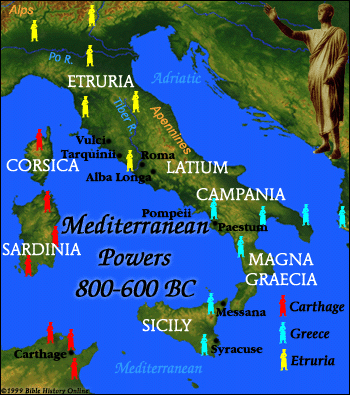
How did the geography and climate of Italy influence the development of Ancient Rome?

Geography affected Rome greatly. Firstly, Rome was located close to the Tiber River, which enabled the people who lived in Rome to trade with other nations, by crossing the Mediterranean Sea. However, Rome was far enough from the sea to be able to avoid navy attacks from other empires, as well as attacks by pirates.
The Tiber River not only represented the route to the sea for the Romans, but it also supplied them with fresh water, and food. Rome was located at a place where the Tiber River could be easily crossed, so many traders stopped at Rome to either rest or trade their goods. Rome was built on seven hills, and those hills provided even more protections against foreign invaders.
The geography of Italy itself helped unite its people. The mountains, Appanines, which run along Italy (from north to south) were not as steep and difficult to cross as Greek mountains, so people had no need to live in small, isolated villages. The mountains also had many flat plains which were ideal for growing crops. The farmland was very good in Italy, and that enabled more people to settle there. Another mountain range, the Alps, which run along the north border of Italy, protected the empire from European invaders. The Alps are very steep and very high.

Tuesday, November 15, 2011

The founding of Rome

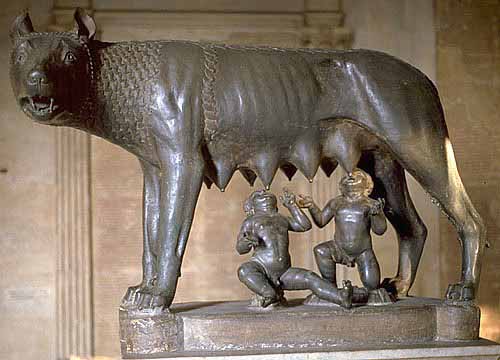
There are two legends that exist about the finding of Rome. The first one is a classical tale about two brothers Romolus and Remus. According to the story, they were left on the banks of the Tiber River, and were found by a wolf. They were raised by a shepherd. Together, they made a decision to build a great city, around the 700s B.C.E. However, they got into many arguments. One day, Remus started mocking a wall/fortress that his brother was building. Romolus got extremely angry, and killed his brother. He, then, later found the great city of Rome. The other tale was written as an epic poem by one of Rome's great poets, called Virgil. According to Virgil, Aenaes, a great Trojan hero, came to Italy (the mouth of the Tiber River), when Troy got captured by Greece. Then, he married a Latin princess, and united the two kingdoms. However, the truth is that historians are not really sure about how Rome was found. The most accpeted theory is that the Latins lived together on the hills of Italy around 1000 B.C.E.They farmed the land, and built small huts. Around the 800 B.C.E. the small Latin communities started joining together for protection, building the foundations of Rome. The Etruscars (people who came from Etruria, in the north of Italy) took control of Rome in 650 B.C.E. They got very rich by mining and trading, as they were excellent metal-workers. They developed and influenced Rome greatly. They built the first wooden and brick houses in Rome, and built the first streets and temples.

     
The two pictures show the epic poet, Virgil, as well as the two brothers Romolus and Remus who supposedly got raised by a wolf and shepherd.