Sunday, October 30, 2011

Does Alexander the Great deserve his title?

I do believe that Alexander the Great deserves his title, because he managed to do things that no one else in that time period did. He conquered many city-states, and gave them the opportunity to grow and develop by giving them money to keep the Greek culture alive, by building temples, etc. Alexander made many great accomplishments after his father, Philip, got killed. He managed to conquer Tyre, which is one of the last Persian bases. He conquered parts of Egypt, and in Egypt he found a great city, Alexandria. Alexander the Great's empire stretched all the way to India!
However, beside conquering many city-states, Alexander also deserved his title because, in my opinion, he was a very strong person. When his father got killed, Alexander took over the empire fairly quickly, even though he was very young, only about 22 years old. It also must have taken a lot of courage to leave his hometown of Pella (the capital of Macedonia) at a young age, and go off with an army of 35,000 soldiers to conquer new lands, and never come back.
Alexander also shows his strength when he died with his army. In summer of 326 B.C.E., Alexander and his army reached the Hyphasis River in India, and led his military through the desert. The conditions in the desert were horrible, and Alexander fell ill. He died in Babylon.
Alexander the Great was a very strong leader, who was determined to spread the Greek culture around the world, and establish new colonies, as well as achieve new conquests. Like it was said in the textbook, "Alexander the Great was a brilliant general. By outwitting enemies, he defeated armies much larger then his own." (page 376).



Thursday, October 20, 2011

A Day In A Life Of A Metic In Athens


I woke with the sun rays beaming from the open door of our small mud brick home. I stand from the uncomfortable straw bed, and go to join my wife, and our two daughters for breakfast. As all of us glance at our neighbors' house, we see their two slaves washing a tunic with hot water. We sigh as we watch the poor woman scrubbing the tunic with her injured, red hands, her dirty black hair hovering in the wind. Of course we feel sorrow for her, but we would give anything to have someone helping us in the house. Of course, the house is not our family's. As foreigners, we cannot own any property in Athens, so we are staying at one of the wealthy land owner's houses. Every month I go to his lavishly decorated home at the bottom of the Acropolis, to pay him with olive oil and grapes, for letting us stay at his house for a while. He ought to kick us out soon though, as he keeps complaining that what we are giving him is not enough. 
For breakfast, we eat a grape each, and drink some water. It is all we can afford right now, as the business is not going as well as we expected. Once we finish eating, everybody goes to their daily chores. My wife immediately starts weaving, hoping that we will be able to sell some of her colorful designs at the agora. My younger daughter takes her clay and starts trying to be helpful, by making a strange, curved pot. All of us laugh, as she is only six, and is not very skilled yet. However, my older daughter is great at making jewelry out of rocks, plants and many other things she finds around Athens. Today I am going to the agora to sell her necklaces, and we are all hoping that it goes well. I take all the trading items, and silently step out of the house into the fresh morning. People are hurrying around everywhere, mothers waving to their sons who are running to school. Men are headed to the agora, some to trade, some to chat, and some to exercise. No one notices me, a poor, scruffy merchant, with his hands full of merchandise. 
As I get closer to the agora, many more people start entering the huge open space. I quickly grab my usual place before any other trader does, and display all of the goods that I have brought. Then, the usual routine starts. I start shouting at the people who pass by "Necklaces! Jewelry! Very cheap!". Some people stop and look at them, others just hurry by quickly, without even noticing me. The first person to buy a necklace is a small, old man, probably buying gifts for his daughter. He picks out a necklace made out of pink thread, and bright orange rocks. In return, I ask for a pint of olive oil, and a few grapes, so that I could pay the land owner once I head back home. The day starts getting extremely hot and unbearable, and the customers stop coming as men go into to the gymnasium for the afternoon. So I decide to end the day, and go see a play in the theatre. Metics are not always allowed to attend plays, but today I am hopeful that I will be let in. 
I take a seat at the very far back, where you can see the whole performance well. It turns out that today a tragedy is being played. Actors take the center stage, and with their depressed, sad-looking masks start saying the lines of their dialogue. After some time, the play finally ends, and the actors bow down, with everyone cheering. I leave the theatre, and head straight home, knowing that I am already quite late. When I get home, I see that my wife has already prepared dinner, a few loaves of bread with olive oil. My daughters devour the loaves ravenously, and my wife and I start talking about how much we miss Thebes, and the life we used to have there. We were citizens, and had many rights. But, now we are in Athens, and we need to focus on getting as wealthy as we possibly can before we go back home. 
After we are finished I say good night to my family, and go to sleep, knowing that tomorrow will be another day of hard work.

Tuesday, October 11, 2011

"The Spartan Way" article summary

Sparta was a great and powerful city-state in Ancient Greece. It was the society of soldiers. The qualities that were widely respected in Sparta were strength, misleading the enemy by telling lies, and feearlessness concerning battle and death. Spartans brutally trained their men, so that they could become a most-feared army in Ancient Greece.
The biggest rival of Sparta was the city-state of Athens. Athens was the home to many artists and thinkers, but also the birthplace of democracy. Sparta was run by an oligarchy of a few powerful and very wealthy families. Spartans, however, left very few writings, and very few artifacts behind, so most of what we know about Sparta today has come from enemies and visitors.
In Spartan society, only 10 percent of men had full citizenship. Citizenship was gained at the age of thrity.  Their only job was to be soldiers in the army. They weren't allowed to persue other jobs and occupations. Spartan soldiers ate their meals in an army mess hall, away from their families, where the food was deliberately bad-tasting.
Sparta had very harsh laws. For example, all newborn babies were inspected by the government, and if they looked unhealthy, they were left on a mountain to die. Also, boys left their homes at the age of seven, when they started training with other children their age. The conditions for them were very difficult. They were beaten, but were expected not to show any suffering or pain. They were provided with very limited amount of food. Girls were also had very difficult training, becuase it was believed that fit women are more likely to give birth to healthy offspring.
Women in Sparta had much more freedom then other women in Greece. They could be owners of land, run businesses, etc.
Beside the women and male citizens of Sparta, there were two other types of people, and those were the perioeci and the helots. The perioeci were the people who lived in towns around Sparta, and provided food for the Spartans. They had no rights whatsoever, but could grow rich as traders or craftsmen. The helots were slaves, and they were owned by Sparta. Their job was to work at the farms of Sparta, and they were treated very cruelly.
After the Peloponnesian War in 404 B.C.E., Sparta beat Athens, and became the most powerful city-state. But, in 371 B.C.E. the city-state of Thebes beat the Spartan army, and Sparta collapsed.

Price, Sean. The Ancient World. N.p.: n.p., n.d. Print. The Spartan Way


Monday, October 10, 2011

The values of Ancient Greeks

a) What values were most important to early Greeks and why were they considered important?

Ancient Greeks had a couple of values that they considered extremely important in their society, and encouraged all their citizens to acquire these values, through myths, stories, legends, etc. These values were intuition, hospitality, justice, ingenuity, loyalty, respect, teamwork and athleticism. These values were created during the age of the Mycenaeans (during the age of heroes), and they soon became the foundation of Greek society. This means that the people who showed these values were considered good citizens, and were more accepted and respected in the Greek society. One of the most famous epic poems from the Ancient Greece, the Odyssey, which was written by Homer, shows these values through many different examples. Penelope shows loyalty, by waiting for her husband Odysseus for ten years, and by rejecting all the other men who come to ask her hand in marriage. Odysseus and his men show teamwork by coping with many difficulties throughout their journey, like being captured by the Cyclops, being turned into pigs by Circe, etc. Another value that was really showed in the Odyssey was athleticism. Odysseus had to be quite athletic in order to shoot the arrow so that he could prove to his wife that he is in fact Odysseus once he comes home. Also, it sure takes a lot of athletic abilities to be able to survive on the sea for ten years.

b) In what ways are early Greeks values found in modern society?

Some of the values of Ancient Greeks are still around, and are still widely respected in different countries, and in different cultures, while some completely faded away. One value that is respected all around the world is ingenuity. People who are always creating new, innovative and interesting products are greatly respected around the world, and their works are considered pieces of art. Athleticism is another value that is widely respected. Great athletes, such as football players, and basketball players earn a lot of money, and are portrayed as idols and role-models. They also get a lot of media attention, and are known world-wide. Another value that is still around in the modern days is justice. People who do not respect laws, and who commit crimes are usually punished for their wrong-doings. Respect is also another value that is considered important in our society. We are always taught to respect opinion, ideas, cultures and religions that are different from our own.
However, one value that is not as respected in the modern times as it was in Ancient Greece is intuition. Back in Ancient Greece, intuition was very important, and it was also considered very important to listen to it. But, nowadays, people rely more on facts and opinions to make decision in life, rather then their gut-feeling.


Sunday, October 9, 2011

The Ancient Olympics article summary

We know that the Olympics started very early in Ancient Greece because the Olympics were mentioned in numerous writings by Ancient Greek poets. The Olympics were held to honor Zeus, the most superior god, and the god of the heavens. The Olympics were always held at a sacred site called Olympia, and all wars and conflicts were stopped during the games, to show respect for the gods. The Olympic Village had many different sporting facilities, including a hippodrome for chariot races, a gymnasium and steam baths.
The first man to win an Olympic event was Coroebus, who won a footrace in 776 B.C.E., the only Olympic event that existed at the time. He was rewarded with olive branches. In Olympic competitions, only the citizens of Ancient Greece were allowed to participate, which means that slaves, foreigners and women were banned from entering the competitions. These citizens needed to be very wealthy, because they needed to have enough money to travel to Olympia, and hold a great banquet and celebration if they won. However, by the time of the 128th Olympics, women were allowed to compete, and the first woman to win an Olympic event was Belisiche from Macedonia.
Like it was said above, Olympics first started out with just footraces, but aftwerwards, more sports were added, chariot racing, wrestling, and even a brutal sport pancratium. In this sport the competitors bit, strangled and kicked each other. This usually resulted in one of the competitors being either injured or killed.
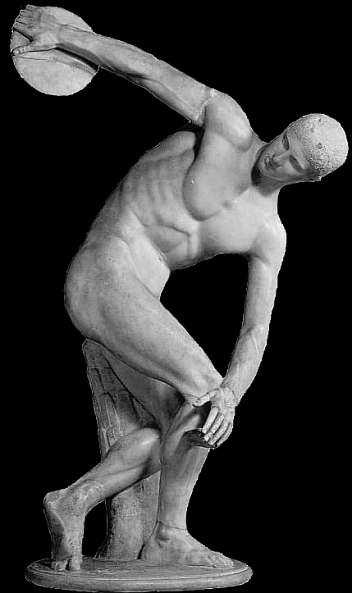
"No matter how great their passion for conflict, however, the Greek's high regard for physical beauty was greater." (Theodore Knight, page 170). This quote shows that despite some of the brutal sports that took place at the Olympics, Greeks appreciated the muscled runners, and pentathlon participants, who were usually the ones awarded.
When the Olympics were very popular, they included five days of different activities, including parades, feasts, etc. Sacrifices were also made. Usually, on the third day of the Olympic festival, 100 cattle were slaughtered to honor Zeus. Olympics didn't only attract athletes, however. Rulers came negotiate with other city-states, while merchants came to trade their goods.
The Olympics started neglecting after the Romans conquered Ancient Greece. They were more interested in war and trade, rather then art, religion, and athletics. During the Roman Olympics, contenstants started cheating, bribery increased, and more brutal events were added. However, around 393 A.D., when Christianity spread, all pagan rituals were banned including the Olympics.
But, in 1896, the Olympic games revived, thanks to Baron Pierre de Coubertin, who organized the first modern Olympic Games in Athens, Greece.

Knight, Theodore. The Ancient World. N.p.: n.p., n.d. Print.