We know that the Olympics started very early in Ancient Greece because the Olympics were mentioned in numerous writings by Ancient Greek poets. The Olympics were held to honor Zeus, the most superior god, and the god of the heavens. The Olympics were always held at a sacred site called Olympia, and all wars and conflicts were stopped during the games, to show respect for the gods. The Olympic Village had many different sporting facilities, including a hippodrome for chariot races, a gymnasium and steam baths.
The first man to win an Olympic event was Coroebus, who won a footrace in 776 B.C.E., the only Olympic event that existed at the time. He was rewarded with olive branches. In Olympic competitions, only the citizens of Ancient Greece were allowed to participate, which means that slaves, foreigners and women were banned from entering the competitions. These citizens needed to be very wealthy, because they needed to have enough money to travel to Olympia, and hold a great banquet and celebration if they won. However, by the time of the 128th Olympics, women were allowed to compete, and the first woman to win an Olympic event was Belisiche from Macedonia.
Like it was said above, Olympics first started out with just footraces, but aftwerwards, more sports were added, chariot racing, wrestling, and even a brutal sport pancratium. In this sport the competitors bit, strangled and kicked each other. This usually resulted in one of the competitors being either injured or killed.
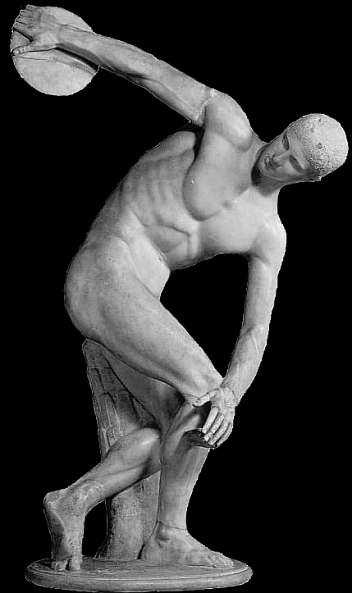
"No matter how great their passion for conflict, however, the Greek's high regard for physical beauty was greater." (Theodore Knight, page 170). This quote shows that despite some of the brutal sports that took place at the Olympics, Greeks appreciated the muscled runners, and pentathlon participants, who were usually the ones awarded.
When the Olympics were very popular, they included five days of different activities, including parades, feasts, etc. Sacrifices were also made. Usually, on the third day of the Olympic festival, 100 cattle were slaughtered to honor Zeus. Olympics didn't only attract athletes, however. Rulers came negotiate with other city-states, while merchants came to trade their goods.
The Olympics started neglecting after the Romans conquered Ancient Greece. They were more interested in war and trade, rather then art, religion, and athletics. During the Roman Olympics, contenstants started cheating, bribery increased, and more brutal events were added. However, around 393 A.D., when Christianity spread, all pagan rituals were banned including the Olympics.
But, in 1896, the Olympic games revived, thanks to Baron Pierre de Coubertin, who organized the first modern Olympic Games in Athens, Greece.
Knight, Theodore. The Ancient World. N.p.: n.p., n.d. Print.
The first man to win an Olympic event was Coroebus, who won a footrace in 776 B.C.E., the only Olympic event that existed at the time. He was rewarded with olive branches. In Olympic competitions, only the citizens of Ancient Greece were allowed to participate, which means that slaves, foreigners and women were banned from entering the competitions. These citizens needed to be very wealthy, because they needed to have enough money to travel to Olympia, and hold a great banquet and celebration if they won. However, by the time of the 128th Olympics, women were allowed to compete, and the first woman to win an Olympic event was Belisiche from Macedonia.
Like it was said above, Olympics first started out with just footraces, but aftwerwards, more sports were added, chariot racing, wrestling, and even a brutal sport pancratium. In this sport the competitors bit, strangled and kicked each other. This usually resulted in one of the competitors being either injured or killed.
"No matter how great their passion for conflict, however, the Greek's high regard for physical beauty was greater." (Theodore Knight, page 170). This quote shows that despite some of the brutal sports that took place at the Olympics, Greeks appreciated the muscled runners, and pentathlon participants, who were usually the ones awarded.
When the Olympics were very popular, they included five days of different activities, including parades, feasts, etc. Sacrifices were also made. Usually, on the third day of the Olympic festival, 100 cattle were slaughtered to honor Zeus. Olympics didn't only attract athletes, however. Rulers came negotiate with other city-states, while merchants came to trade their goods.
The Olympics started neglecting after the Romans conquered Ancient Greece. They were more interested in war and trade, rather then art, religion, and athletics. During the Roman Olympics, contenstants started cheating, bribery increased, and more brutal events were added. However, around 393 A.D., when Christianity spread, all pagan rituals were banned including the Olympics.
But, in 1896, the Olympic games revived, thanks to Baron Pierre de Coubertin, who organized the first modern Olympic Games in Athens, Greece.
Knight, Theodore. The Ancient World. N.p.: n.p., n.d. Print.

No comments:
Post a Comment